How to Write a Nepali Wedding Invitation: Step-by-Step Guide
A step-by-step guide to writing a Nepali wedding invitation: who the host is, which side’s card you are writing, honorifics like चि. and सौ.का., dates in Bikram Sambat, and the closing lines.
Bihekocard Team4 min read
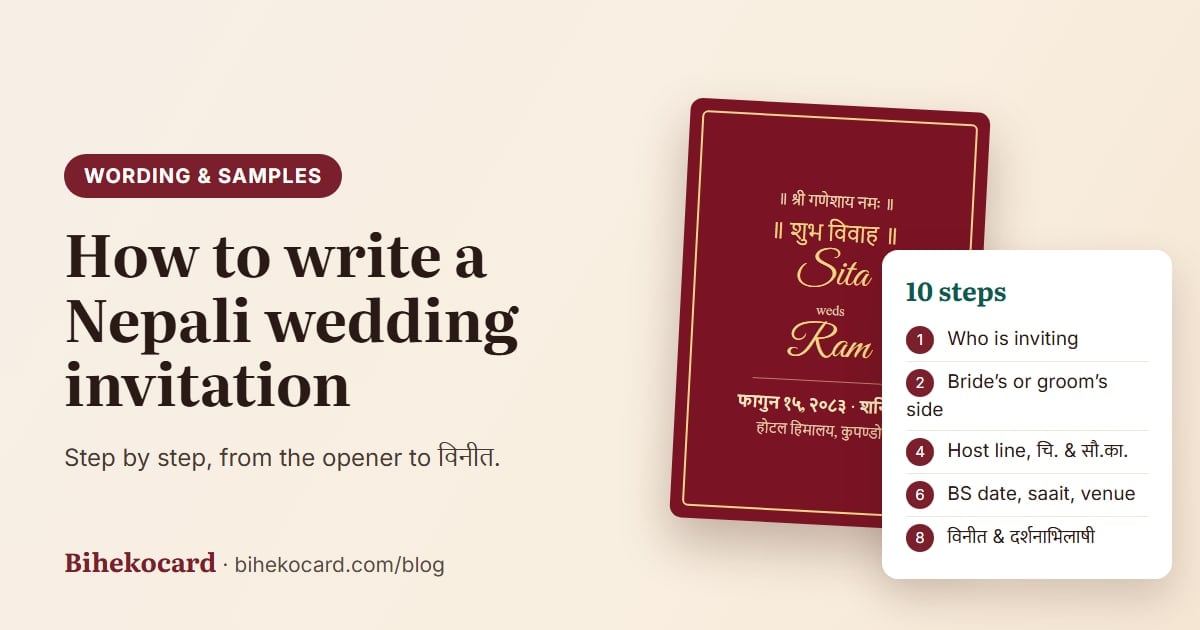
A Nepali wedding invitation looks complicated because of the formal words, but every card is built from the same few decisions. Make them in order and the wording almost writes itself. This guide walks through each step. If you would rather start from a finished card, jump to the wedding invitation wording examples.
Step 1: Decide who is inviting
A traditional bihe ko card is not written by the couple. It is a request from the hosts, usually the parents. Decide this first, because it sets every other word.
- Parents: the most common. The card says हाम्रो सुपुत्र (our son) or हाम्रो सुपुत्री (our daughter).
- Grandparents: common in joint families. Use नाति (grandson) or नातिनी (granddaughter).
- The couple: fine for modern cards and friends. Write in the first person: हामी सीता र राम...
Step 2: Decide whose side the card is for
In most Nepali weddings each family sends its own card to its own guests. The two cards are mirror images:
- The bride’s side card names the daughter first and centres on the wedding ceremony, kanyadan and the venue.
- The groom’s side card names the son first and adds the janti departure time and place, and often the reception.
If the families share one card, name both sets of parents and list every event.
Step 3: Choose the opener
The first line sets the tone. Choose one:
- ॥ श्री गणेशाय नमः ॥ (the usual Hindu opener, often with a Ganesh image)
- ॥ शुभ विवाह ॥ (auspicious wedding, used alone or under the Ganesh line)
- ॥ शुभ इहिपा ॥ for Newar families, सेवारो for Kirat families, Bismillah for Muslim families, Tashi Delek for Buddhist families
Step 4: Write the host line
This is the main sentence of the card. The pattern is:
हाम्रो सुपुत्र/सुपुत्री [honorific + name] को शुभ विवाह [place] निवासी श्री [father] तथा श्रीमती [mother] का सुपुत्र/की सुपुत्री [honorific + name] सँग निम्न मिति र साइतमा हुने भएकाले ...
Use the right honorific before each name:
- चि. (चिरञ्जीवी) before the groom’s name.
- चि. सौ. का. (सौभाग्यकाङ्क्षिणी) before the bride’s name.
- श्री before a man’s name and श्रीमती before a married woman’s name, for the parents.
The full list of words is in विवाहको निमन्त्रणा पत्रमा लेख्ने शब्दहरू.
Step 5: Add the request
End the host line with a polite request. Pick one level of formality and keep it:
- उक्त शुभ अवसरमा यहाँको सपरिवार उपस्थितिको हार्दिक अनुरोध गर्दछौं। (formal)
- सपरिवार पाल्नुभई नवदम्पतीलाई आशीर्वाद दिनुहुन सादर अनुरोध गर्दछौं। (formal, asks for blessings)
- तपाईंको साथ पाउँदा हामी खुसी हुनेछौं। (warm, for couples writing themselves)
Step 6: Write the date, saait and venue
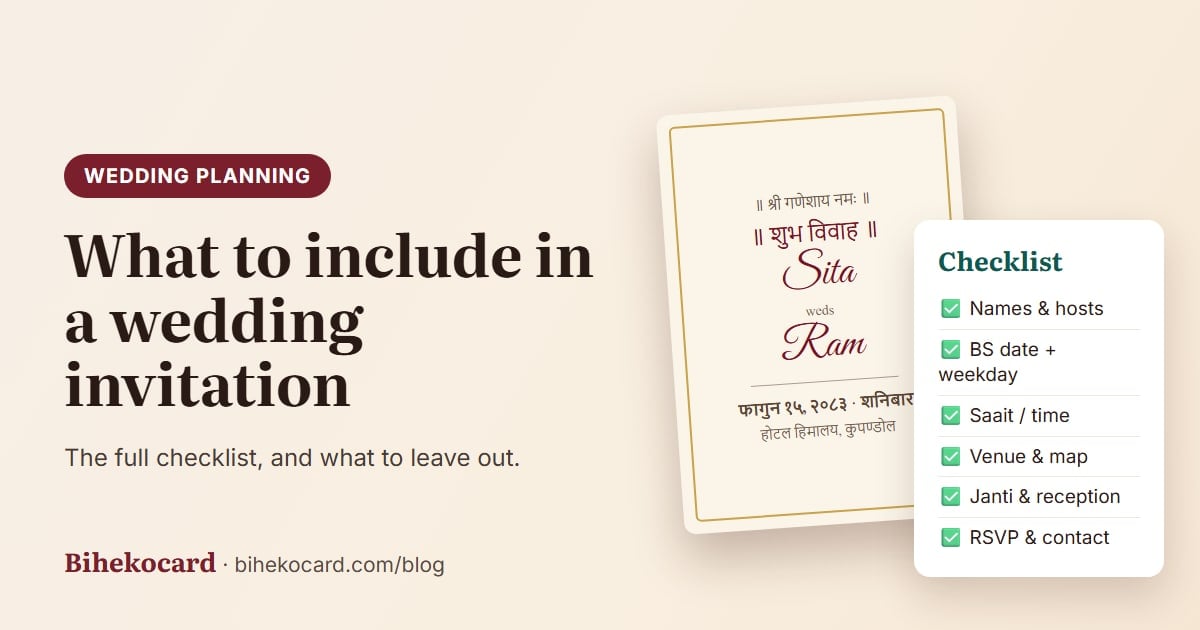
- Date: Bikram Sambat first, with the weekday: मिति: २०८३ साल फागुन १५ गते, शनिबार. Add the English date in brackets if relatives abroad will read it.
- Saait: the exact time from the family priest: शुभ साइत: बिहान १०:३० बजे. Some families also print the tithi.
- Venue: the name plus the area: स्थान: होटल हिमालय, कुपण्डोल, ललितपुर.
Convert dates carefully. A BS date with the wrong weekday is the most common error on printed cards. A card maker that fills in the BS date and tithi from the English date avoids this.
Step 7: List the other events
Only list events the reader is invited to. Typical lines:
- जन्ती प्रस्थान: [time], [place]बाट
- मेहन्दी, हल्दी: [date, time, place]
- प्रीतिभोज: [date], बेलुका [time] बजेदेखि, [place]
If close family is invited to five events and colleagues only to the reception, make two versions of the card rather than one confusing one.
Step 8: Close the card
- विनीत (humbly yours) followed by the hosts’ names.
- दर्शनाभिलाषी (eager to see you) followed by siblings, nephews and nieces. Optional, but loved by children.
- A contact number or an RSVP line, so guests can confirm.
Step 9: Write the English version (optional)
Keep the same order: hosts, request, couple, date in both calendars, time, venue. Do not translate word for word. “Request the pleasure of your company” reads better than a literal “request your presence with family”.
Step 10: Proofread with both families
Send a draft to both sides before printing or sharing. Check spellings of every name, the parents’ titles, the date, weekday and time. A digital card can be corrected after it is sent; a printed one cannot.
Turn your text into a card
Once the wording is ready, choose a design from the Nepali wedding card templates and design the wedding card online, free. Each line above has its own place on the card, so you only replace the sample text. See also what to include in a wedding invitation for a final checklist.