Digital Wedding Card vs Traditional Printed Card: Which Should You Choose?
An honest comparison of digital and printed wedding cards in Nepal: cost, time, elders, relatives abroad, RSVPs, changes after sending, and why most families now use both.
Bihekocard Team3 min read
A generation ago, a bihe ko card meant a box of printed cards from the press in Bagbazar or Ason, delivered by hand over several weekends. Today most invitations in Nepal travel by WhatsApp and Viber. Families planning a wedding now ask the same question: do we still need printed cards, or is a digital card enough?
Here is an honest comparison, including where printed cards still win.
The short answer
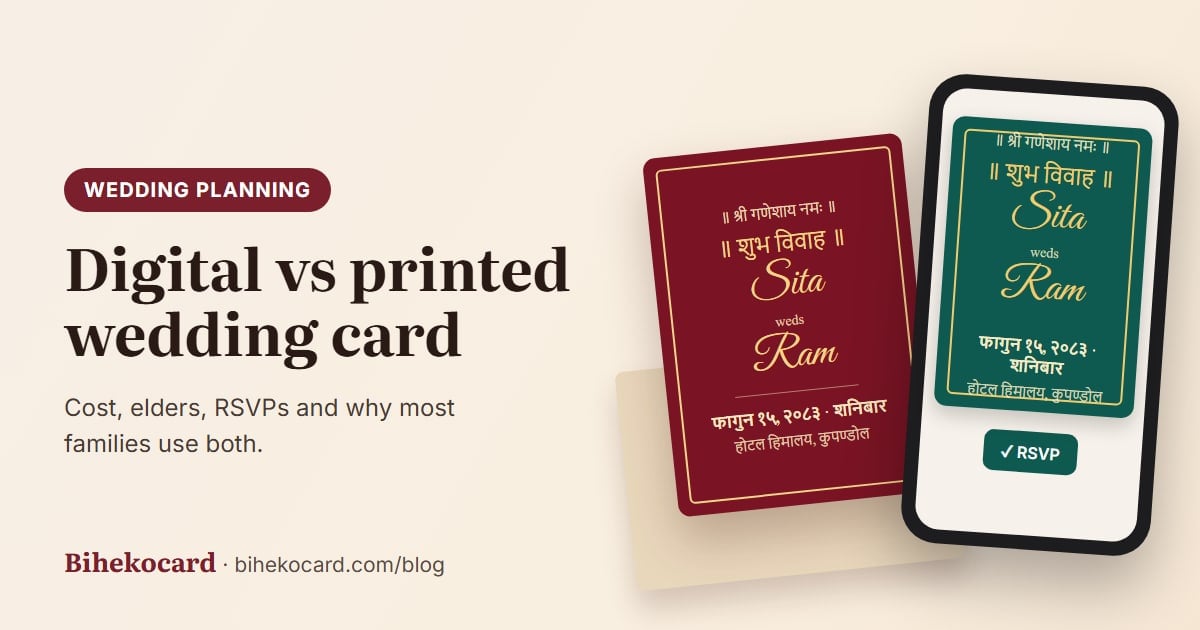
For most families, the best choice is both: a digital card for nearly everyone, and a small number of printed cards for elders and the closest relatives who expect a card in hand. Design once, then share the link and print a few copies of the same design.
Side-by-side comparison
- Cost: printed cards cost per piece, plus envelopes and delivery. A digital card costs the same whether you send it to 50 or 1,000 guests.
- Time: printing takes days to weeks, and hand delivery takes weekends. A digital card can be designed and sent the same day.
- Reach: a digital card reaches relatives in Qatar, Malaysia, Australia or the US instantly. A printed card has to be posted or photographed.
- Changes: if the venue or time changes, a digital card updates for everyone. Printed cards need a reprint or a round of phone calls.
- RSVP: a digital card can have an RSVP button and a guest list. Printed cards rely on phone calls.
- Maps: a digital card can open the venue in Google Maps. A printed card only has the address.
- Feeling and tradition: a printed card feels formal and is easy to keep. Many elders see it as the respectful way to invite.
- Keepsake: a printed card can be framed or kept in an album. A digital card can be saved as a PDF or printed later.
When a printed card still makes sense
- Grandparents and senior relatives who do not use smartphones.
- Families where hand-delivering the card with a visit is part of the custom.
- Inviting the priest, the guru or important community members.
- A keepsake copy for the couple and both families.
Even then, the number is usually small: twenty to fifty cards rather than five hundred.
When a digital card is better
- Friends, colleagues and the extended family who live on WhatsApp and Viber.
- Relatives abroad. See wedding invitations for relatives abroad.
- Weddings with several events, where each ceremony needs its own date, time and place.
- Short notice weddings, when there is no time for printing.
- When you need to know headcount for catering.
Is a digital card disrespectful to elders?
Not if you send it properly. The disrespect comes from a card forwarded with no words, not from the format. Call the closest elders first, then send the card with a personal line, or give them a printed copy of the same design. Our guide to WhatsApp invitation messages in Nepali has respectful wording for elders.
What a good digital wedding card should have
- The full card wording, not just a photo with names.
- The Bikram Sambat date with the weekday, and the English date for guests abroad.
- A link that opens on any phone without installing an app.
- A map button for each venue.
- An RSVP button, so you are not counting replies in chat. See digital wedding invitations with RSVP.
- A print-ready PDF of the same design for the printed copies.
A practical plan
- Design the card once, online.
- Download a PDF and print a small batch for elders and keepsakes.
- Call close family, then send the link with a personal message.
- Send the link to everyone else three to four weeks before the wedding.
- Check RSVPs a week before and send a reminder.
Make one card for both
With Bihekocard you design your wedding card online for free and get both: a link for WhatsApp and Viber, and a PDF to print. Start with the wedding card templates or make your बिहेको कार्ड in Nepali.