How to Plan a Wedding Guest List in Nepal: A Step-by-Step Guide
A Nepali wedding guest list can run to hundreds of households across two families. Here is a simple way to build it, split it by side and ceremony, and track who has opened the invitation and replied.
Bihekocard Team5 min read
In Nepal the guest list is rarely just the couple's. Parents, grandparents, uncles and aunts on both sides all have people who must be invited, and a wedding of three or four hundred households is common. The list decides the venue, the number of plates at the bhoj and a large share of the budget, so it pays to build it carefully.
The short version: start with the closest family and work outward, count households rather than names, split the list by bride's and groom's side, decide which ceremonies each guest is invited to, and collect phone numbers early so you can send and track the invitations.
Step 1: Build the list from the inside out
Start with the people who cannot be left off, then add each wider circle. Working outward keeps the most important guests safe when you later need to trim.
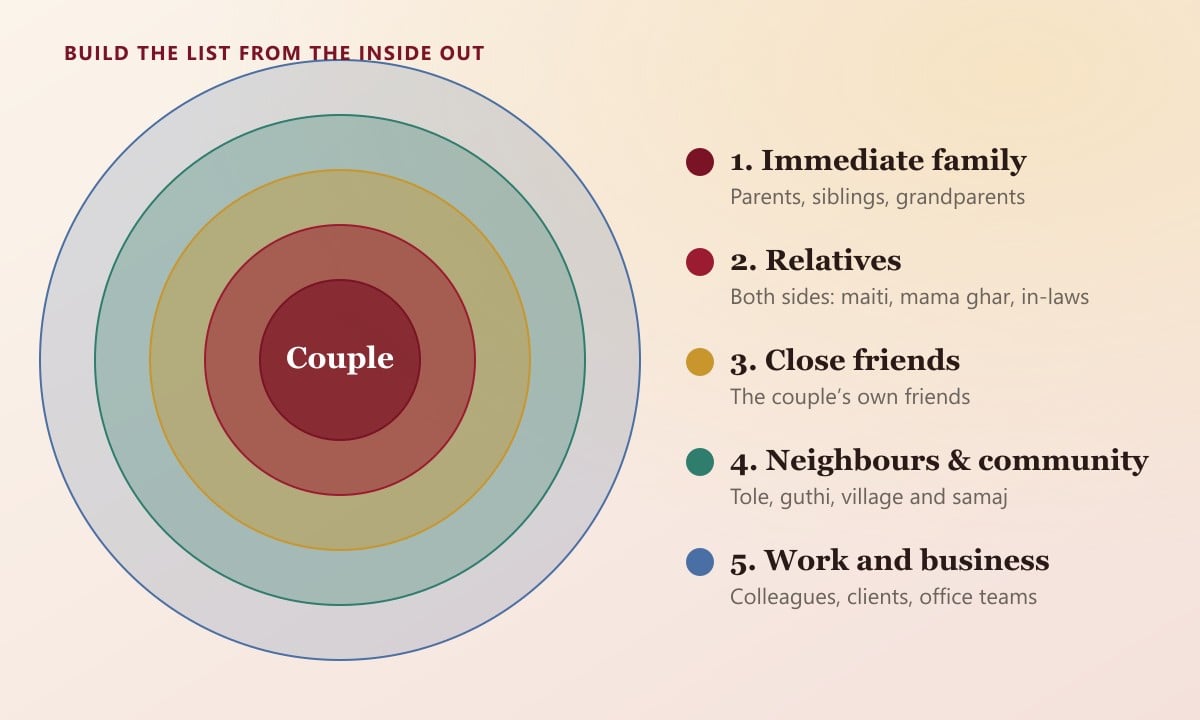
- Immediate family: parents, siblings and grandparents on both sides.
- Relatives: the maiti and mama ghar, cousins, and the families the couple are marrying into.
- Close friends: the couple's own friends from school, college and home.
- Neighbours and community: the tole, guthi, village and samaj your family belongs to.
- Work and business: colleagues, clients and the parents' professional circles.
Ask each set of parents to write their list by circle, then merge them. Relatives who appear on both lists are the ones most likely to be invited twice, so mark them as you go.
Step 2: Count households, not just names
Most Nepali invitations are addressed to a whole family, with the words सपरिवार (with family) or "& Family" after the name. One line on your list can mean one person or six.
Give every household an estimated headcount as you add it. The total of that column, not the number of rows, is what the party palace and caterer need. A list of 250 households can easily become 700 people.
Step 3: Split the list by side
Record whether each guest belongs to the bride's side or the groom's side. It sounds obvious, but it answers three practical questions later:
- Who sends the invitation, and in whose name the card is written.
- How many seats each family needs at the ceremony and the reception.
- Who to call when a guest has not replied, because the right person to follow up is the one who knows them.
Step 4: Decide which ceremonies each guest gets
Many weddings in Nepal run over several days: mehendi, haldi, sangeet, the wedding itself and a reception. Not every guest is invited to every event. The mehendi and haldi are usually for close family and friends, while the reception is for everyone.
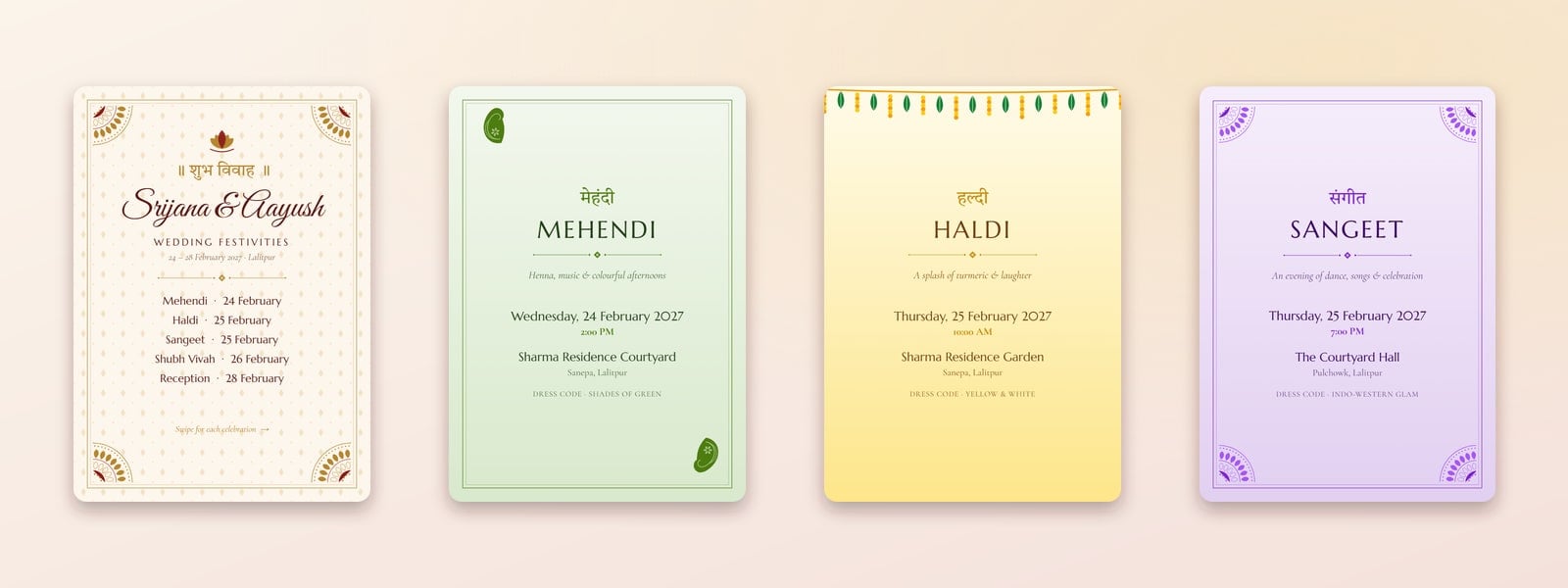
Add a column for the ceremonies each household is invited to. With a multi-page ceremony card, every event gets its own page with its own date, time and venue, so guests always see where they need to be and when.
Step 5: Collect phone numbers early
Almost every invitation in Nepal now arrives on WhatsApp or Viber, even when a printed card follows for elders. The slowest part of sending is finding numbers, so collect them while you build the list, not the week before the wedding.
Save numbers with the country code (for example +977 for Nepal). For family in the Gulf, Malaysia, Australia, the UK or the US, the same link works anywhere; see our guide to invitations for relatives abroad.
Step 6: The columns your guest list needs
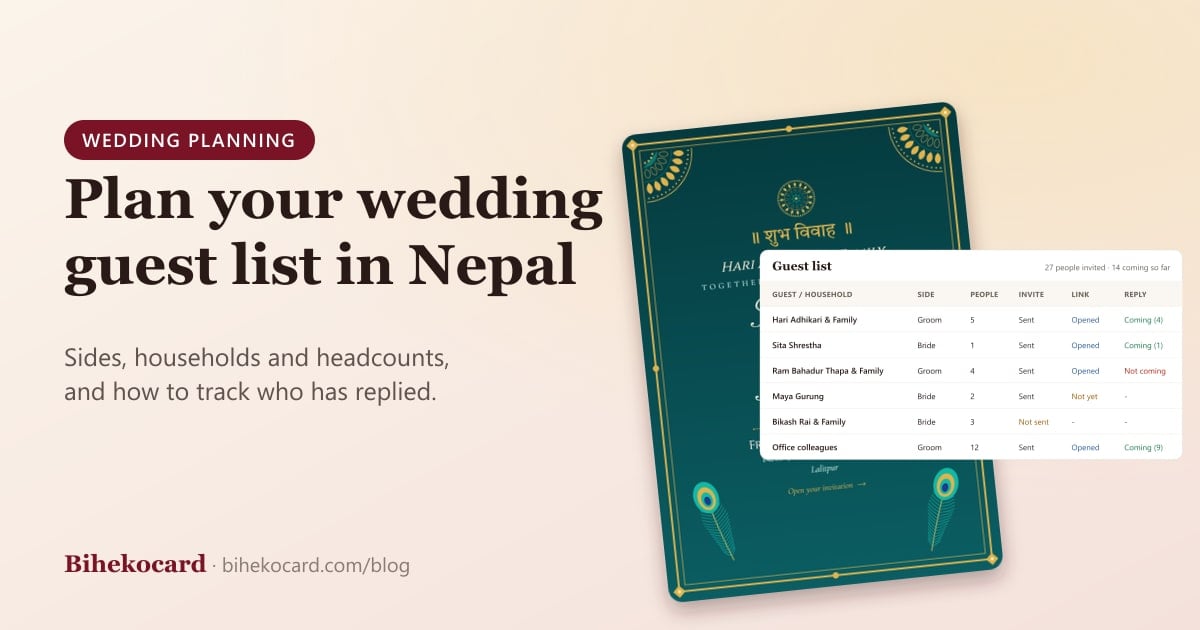
A simple spreadsheet or a guest list tool only needs a handful of columns. Keep it to these and it stays easy for both families to update.
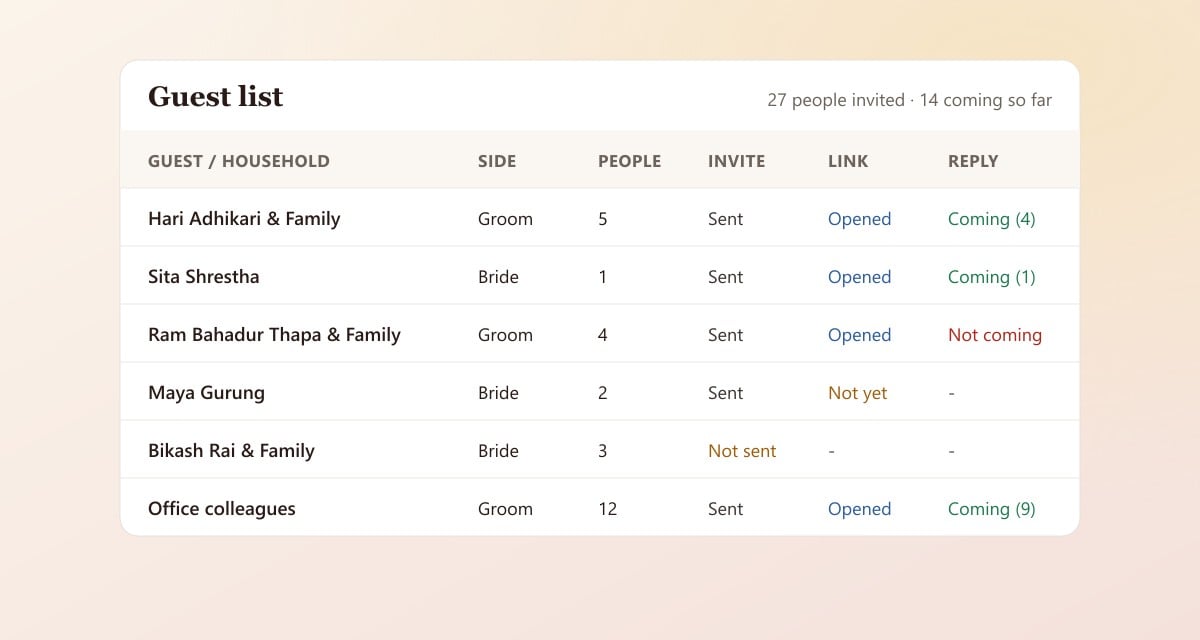
| Column | Why it matters |
|---|---|
| Name or household | How the guest is addressed, for example Hari Adhikari & Family |
| Side | Bride's or groom's family |
| People | Estimated headcount for the household |
| Phone | Where the invitation is sent |
| Ceremonies | Which events they are invited to |
| Invite sent | So nobody is missed or sent twice |
| Opened | Whether they have actually seen it |
| Reply | Coming or not, and how many people |
Step 7: Send personal invitations and track replies
A personal invitation still matters in Nepal. With a digital card, each household can receive its own link that shows their name on the card, so it feels addressed to them rather than forwarded from a group.

On Bihekocard you can paste your list straight from Excel (name and WhatsApp number), send each guest their personal link on WhatsApp in one tap, and see who has opened it and who has replied. Replies add up into a live headcount you can export for the caterer. Read more about digital invitations with RSVP.
A few days after sending, sort the list by opened. Anyone who has not opened the link is the right person to call, and a quick call from the right side of the family usually settles it.
Common guest list mistakes
- Inviting shared relatives twice. Merge both families' lists early and mark overlaps.
- Counting names instead of people. "& Family" can mean five plates.
- Forgetting the helpers. The priest, photographers, drivers and people helping in the kitchen also need to be fed and seated.
- No buffer for late additions. Elders will remember someone in the final week. Keep a little room in the numbers you give the venue.
- Not updating after replies. A list that is not updated is just a guess. Update it as replies come in, not the night before.
For how many invited guests usually attend, and when to send the cards, see invitations in Nepal: cost, timing and etiquette.
Your guest list checklist
- Each family writes its list by circle, then the lists are merged.
- Every household has a headcount and a side.
- Ceremonies are marked for each household.
- Phone numbers are saved with the country code.
- Personal invitations are sent and marked as sent.
- Unopened invitations are followed up by phone.
- The final headcount goes to the venue with a small buffer.
Ready to start? Choose a card, add your guest list and send your first personal invitation today.